When a fire tears through a home or commercial building, the cleanup that follows is just as critical as the initial emergency response. One of the most consequential decisions a restoration contractor or property owner will face is choosing the right blasting method for removing char, soot, and smoke residue. The debate around dry ice blasting vs. soda blasting fire damage removal has grown significantly in recent years, and for good reason. Both methods offer advantages over traditional wire brushing or chemical scrubbing, yet they differ dramatically in cleanup requirements, surface compatibility, odor elimination effectiveness, and overall project cost.
If you are exploring options for dry ice blasting for fire damage restoration as a primary remediation strategy, this guide breaks down the key differences so you can make a fully informed decision before the first pellet or grain hits the surface.
What Is Dry Ice Blasting?
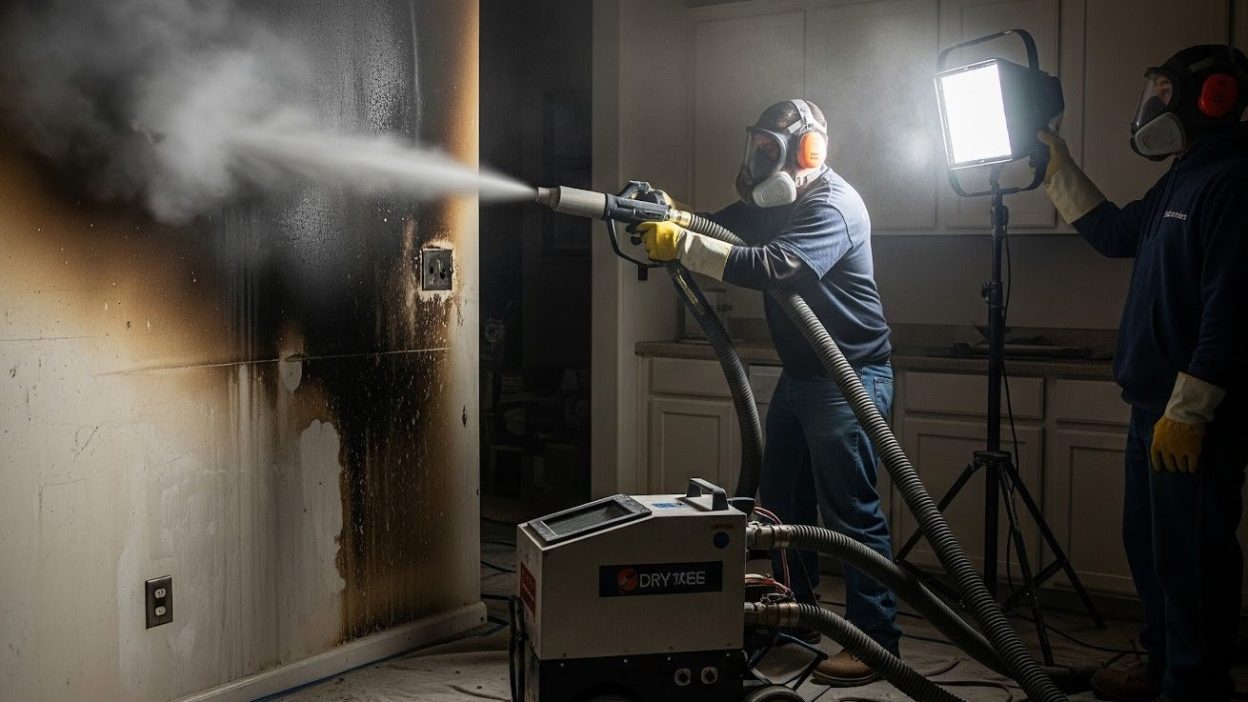
Dry ice blasting is a form of cleaning and surface preparation that uses solid carbon dioxide (CO2) pellets as the blasting medium. These pellets are accelerated through a pressurized nozzle and strike the contaminated surface at high velocity. Upon impact, the pellets sublimate, meaning they transition directly from a solid state to a gaseous state, leaving no secondary residue behind.
The process works through three mechanisms: kinetic energy from the pellet impact, a micro-thermal shock that causes contaminants to crack and separate, and the rapid gas expansion that lifts debris away from the substrate. Because the medium disappears after use, the only cleanup required is collecting the displaced soot and char.
According to the Dry Ice Blasting Association, the technology has been used across industrial, food processing, and restoration industries for decades, with fire damage remediation becoming one of its fastest-growing applications.
What Is Soda Blasting?
Soda blasting uses sodium bicarbonate, commonly known as baking soda, as the abrasive medium. The granules are propelled against contaminated surfaces to remove char, soot, and mold. It is a gentler abrasive than sand or glass beads, which makes it popular for surfaces that cannot withstand aggressive mechanical action.
Soda blasting has long been used in automotive restoration and fire remediation because of its mild abrasiveness and the fact that baking soda carries some natural deodorizing properties. However, as detailed in the sections below, it generates a substantial volume of secondary waste and requires significant post-process cleanup.
Secondary Waste: The Hidden Cost Comparison
One of the most significant differences between these two methods is what they leave behind after the blasting process is complete.
Dry ice blasting produces zero secondary waste. Because the CO2 pellets sublimate on contact, they simply disappear. The only material left on the floor or surrounding surfaces is the dislodged soot, ash, and char that was removed from the substrate. This dramatically reduces labor hours, as cleanup crews only need to collect the displaced contaminants rather than also managing pounds of spent blasting media.
Soda blasting generates substantial secondary waste. Sodium bicarbonate particles do not disappear after use. They land on floors, inside wall cavities, on electrical components, in HVAC ducts, and across every horizontal surface within the blast zone. In a residential fire restoration project, this can mean hundreds of pounds of bicarbonate residue mixed with soot and ash that must be carefully collected, bagged, and disposed of before any reconstruction work can begin.
The secondary cleanup after soda blasting can add anywhere from several hours to multiple days of additional labor, depending on the size of the structure. This directly impacts both labor costs and total project timelines. The Insurance Institute for Business and Home Safety notes that extended project timelines in fire restoration can increase costs significantly due to temporary housing, extended equipment rental, and delayed reconstruction.
Smoke Odor Elimination: Removal vs. Encapsulation
Smoke odor is one of the most persistent challenges in fire restoration. Soot particles penetrate porous materials and continue off-gassing long after the visible char has been removed. How each blasting method addresses this issue is a critical factor in long-term restoration success.
Dry ice blasting physically removes smoke residue rather than encapsulating it. By stripping soot and char down to a clean substrate, the process eliminates the source of the odor. When combined with proper air scrubbing and HEPA filtration, properties treated with dry ice blasting can achieve odor clearance within 24 hours of treatment in many cases. The absence of secondary media also means no residual chemical smell is introduced during the process.
Soda blasting can neutralize some odor compounds, as sodium bicarbonate is a natural deodorizer. However, because the process is primarily abrasive rather than thermally aggressive, it may not fully penetrate deeply embedded soot in porous substrates like rough-sawn lumber or brick mortar. In many cases, soda blasting addresses surface-level odor while leaving deeper residue intact. Properties treated by soda blasting sometimes require additional ozone treatments or chemical sealants to manage lingering smoke smell, adding another layer of cost and time to the project.
For a thorough explanation of how smoke residue bonds to building materials, the Environmental Protection Agency’s Indoor Air Quality resources provide useful background on combustion byproducts and surface infiltration.
Surface Compatibility: Where Each Method Excels
Not all fire-damaged surfaces respond the same way to blasting, and choosing the wrong method can cause additional damage that results in demolition costs that were otherwise avoidable.
Structural Wood Joists and Framing
Dry ice blasting is widely preferred for structural wood because it cleans aggressively without removing sound wood fiber. The sublimation process lifts char and soot without introducing moisture, which is particularly important in preventing secondary mold growth. Many restoration projects using dry ice blasting are able to retain structural members that would otherwise be condemned and replaced.
Soda blasting can also clean wood joists effectively, but the bicarbonate residue that settles into the grain and between joists requires thorough removal before any coatings or sealants are applied. If the residue is not fully removed, it can interfere with paint and primer adhesion and create a substrate problem during reconstruction.
Brick and Masonry
Both methods can be used on brick, but dry ice blasting is typically preferred for mortar joints and older brick that may be softer or more porous. The non-abrasive nature of the sublimation process means there is less risk of eroding the mortar or surface of the brick itself. Soda blasting, while relatively gentle, can still remove mortar fines over time if applied aggressively.
Electrical Panels and Components
This is where dry ice blasting has a decisive advantage. Because dry ice blasting produces no secondary waste, it can be used to clean electrical panels, junction boxes, wiring conduit, and other sensitive components without leaving a conductive or corrosive residue. In fact, many industrial equipment manufacturers specifically recommend dry ice blasting for electrical systems because it is non-conductive.
Soda blasting should generally not be used near live or sensitive electrical components. Sodium bicarbonate is slightly conductive when wet and can accelerate corrosion on metal contacts. In fire-damaged buildings where electrical systems may have been heat-stressed, introducing a potentially corrosive media is an avoidable risk.
Metal Sheathing and Structural Steel
For metal surfaces, both methods can be effective, but the choice depends on the desired final finish and whether the surface will be painted or coated. Dry ice blasting leaves a clean metal surface ready for coating without introducing abrasion marks. Soda blasting, being slightly abrasive, can create a surface profile that promotes adhesion for paints and coatings but also requires careful media removal before application.
Speed and Project Timeline
Time directly translates to money in fire restoration, both in terms of contractor labor costs and in terms of displaced residents or tenants who are incurring living expenses while their property is being restored.
Dry ice blasting generally moves faster per square foot on heavily contaminated surfaces because the operator does not need to pause to manage accumulating media. On a typical residential structural remediation project, dry ice blasting can clean exposed framing, joists, and decking significantly faster than soda blasting when factoring in both the blasting time and the post-blast cleanup time.
Soda blasting can be competitive in speed during the blasting phase itself, but the total project timeline extends once the secondary waste removal phase begins. For large open spaces like warehouse floors or commercial buildings, this cleanup phase can represent a substantial portion of the total project hours.
Cost Breakdown
Direct cost comparison between the two methods depends on project size, regional pricing, and the complexity of the structure, but the following general framework applies across most markets.
The equipment and media cost for dry ice blasting tends to be higher per hour than soda blasting, as CO2 pellets require a reliable supply chain and the blasting machines represent a significant equipment investment. However, when total project costs are calculated including post-blast cleanup labor, waste disposal, and any secondary odor treatments required, dry ice blasting frequently proves to be the more cost-effective option.
For property owners and insurance adjusters comparing bids, it is worth requesting a total project cost estimate rather than comparing only the blasting rate. Projects that appear more expensive on day one using dry ice may close out at a lower total cost due to reduced secondary labor and avoided demolition.
When Soda Blasting May Still Be the Right Choice
Soda blasting remains a legitimate tool in the restoration industry and is appropriate in certain scenarios. For exterior applications where secondary waste can be washed away with water, the cleanup concern is largely neutralized. Soda blasting can also be preferable for certain automotive or marine restoration applications, or when the project budget requires a lower upfront equipment cost and additional labor is available to manage the cleanup phase.
In mixed-use projects, some contractors deploy dry ice blasting for interior structural components and electrical areas while using soda blasting on exterior masonry where the waste management concern is minimal.
Final Assessment: Making the Right Call for Fire Restoration
Why Dry Ice Blasting Leads in Most Fire Restoration Scenarios
After evaluating secondary waste generation, odor elimination effectiveness, surface compatibility, and total project cost, dry ice blasting holds a clear advantage for the majority of interior fire restoration projects. Its ability to clean to a bare substrate without introducing additional cleanup challenges, combined with its suitability for sensitive surfaces like electrical systems and structural wood, makes it the preferred method for contractors focused on quality outcomes and efficient timelines.
Soda blasting remains a capable and cost-accessible option, particularly for exterior applications or projects where post-blast cleanup is logistically manageable. However, for full structural remediation after interior fire damage, the zero-secondary-waste advantage of dry ice blasting typically delivers a faster project completion and a more thorough smoke odor resolution.
For property owners and contractors located in the region seeking professional evaluation of blasting options for a specific fire-damaged structure, consulting with a specialist in dry ice blasting fire damage restoration can help clarify which approach best fits the scope, budget, and timeline of the project.
Frequently Asked Questions
Q1: Is dry ice blasting safe to use inside a fire-damaged home?
Yes. Dry ice blasting uses CO2, which is non-toxic in proper ventilation conditions. Restoration professionals follow safety protocols including adequate ventilation and respiratory protection to ensure safe working conditions. The process does not introduce moisture or chemical agents into the structure, making it suitable for occupied remediation zones when proper precautions are taken.
Q2: How long does dry ice blasting take for a typical house fire?
Project duration varies based on the scope of damage, but a single-family home with moderate fire damage to structural framing and subfloor areas can often be fully blasted within one to three days by a professional crew. This estimate includes the cleanup of displaced soot but does not require the extended secondary media cleanup that soda blasting demands.
Q3: Will soda blasting residue harm my HVAC system?
Sodium bicarbonate residue that enters HVAC ductwork can create problems including reduced airflow, potential corrosion of metal components, and re-contamination of cleaned areas during system operation. HVAC systems in soda-blasted structures should be thoroughly cleaned and inspected before being returned to service.
Q4: Can dry ice blasting remove mold in addition to fire damage?
Yes. Dry ice blasting is also an effective mold remediation tool. Because fire-damaged structures are often exposed to water from firefighting efforts, mold growth can develop concurrently with smoke damage. Dry ice blasting can address both issues in a single treatment phase, potentially reducing overall project costs and timelines.
Q5: Does insurance typically cover dry ice blasting for fire damage?
Most homeowner and commercial property insurance policies cover reasonable and necessary costs for professional fire remediation, which can include dry ice blasting when it is the recommended method for the type of damage present. Property owners should document all estimates and consult with their adjuster before work begins. For complex claims, independent public adjusters can help ensure that specialized remediation methods are properly covered under the policy terms.