Opening or expanding an automotive dealership in Florida involves far more than securing a prime location and stocking inventory. Before a single shovel breaks ground, developers and entrepreneurs must navigate a layered set of regulations that govern everything from showroom square footage to service bay ventilation. Understanding car dealership building requirements in Florida early in the planning process prevents costly redesigns, permit delays, and compliance violations. Whether you are developing a new facility from the ground up or renovating an existing commercial property, working with an experienced team that specializes in automotive dealership construction will help you align every phase of the project with current Florida statutes, municipal zoning codes, and federal accessibility standards.
Florida Zoning Classifications for Automotive Dealerships
Automobile dealerships are generally classified under commercial or highway-commercial zoning districts in Florida municipalities. Each county and city maintains its own land development regulations, so the exact designation varies. Common zoning categories that typically permit new or used vehicle sales include C-2 (General Commercial), C-3 (Heavy Commercial), and PD (Planned Development) districts.
Before purchasing land, developers should request a zoning verification letter from the local planning department and confirm that vehicle sales, service, and display are listed as permitted or conditional uses within that district. Conditional use approval often requires a public hearing and additional site-specific findings, adding weeks or months to the permitting timeline.
Florida Statute 320.27 governs motor vehicle dealer licensing at the state level and requires that a licensed dealership maintain a bona fide established place of business. This means the physical facility must meet minimum operational standards before the Florida Department of Highway Safety and Motor Vehicles (FLHSMV) will issue or renew a dealer license. Zoning compliance is a prerequisite of the state licensing process, making early municipal coordination essential.
Minimum Showroom and Outdoor Display Requirements
Florida does not impose a single statewide showroom square-footage minimum for dealerships. Instead, municipalities set their own thresholds through local zoning ordinances and design standards. However, certain benchmarks have emerged as practical industry norms across the state.
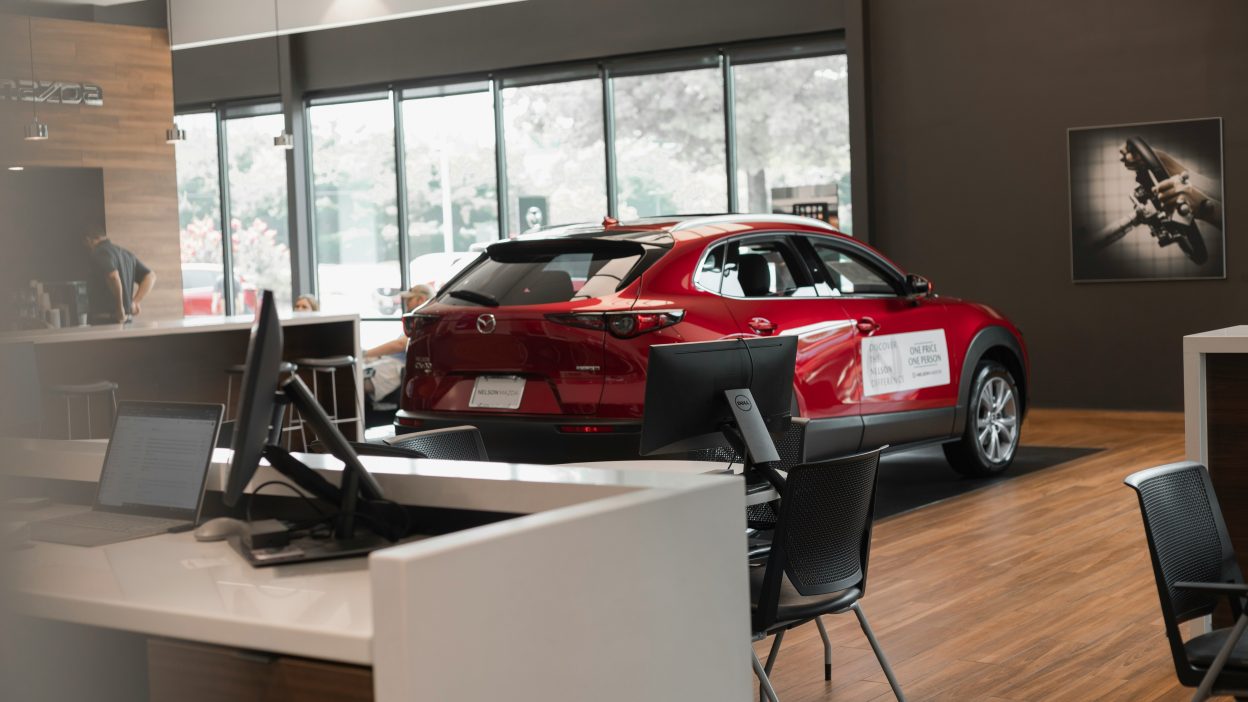
Most mid-size Florida cities require a permanent, enclosed showroom of at least 1,000 to 1,500 square feet for franchised new-vehicle dealers. Some larger markets, including Miami-Dade and Broward Counties, have updated their commercial automotive standards to reflect contemporary consumer expectations, with showroom areas commonly ranging from 3,000 to 10,000 square feet for full-line franchise operations.
Outdoor vehicle display areas are subject to setback requirements that keep parked inventory away from public rights-of-way and adjacent property lines. Standard setbacks for display lots in Florida typically range from 10 to 25 feet from a front property line, with side and rear setbacks of 5 to 15 feet depending on the municipality. Display areas must also conform to landscaping buffer ordinances, which usually require a continuous planting strip of specific width and plant density between the display lot and public streets.
Lighting for outdoor display is another regulated element. Florida municipalities frequently adopt International Dark Sky compliant standards or equivalent local ordinances that cap foot-candle levels at property boundaries to reduce light trespass into residential neighborhoods. Dealership developers should work with a licensed lighting engineer to design a photometric plan that meets display-area minimums (often 10 to 30 foot-candles at the vehicle surface) while staying within boundary maximums.
ADA Compliance for Automotive Facilities
The Americans with Disabilities Act (ADA) applies to any commercial facility open to the public, and car dealerships are no exception. While the general ADA Standards for Accessible Design cover most requirements, automotive facilities have some unique considerations compared to standard retail or office buildings.
Accessible parking spaces must be provided at a ratio tied to total parking lot capacity. For lots with 1 to 25 spaces, one accessible space is required. The ratio increases as lot size grows. Accessible spaces must be located on the shortest accessible route to the primary entrance, which for a dealership typically means prioritizing customer-facing entrances over service drive entries.
Showroom floors present accessibility considerations around floor surface texture and transition strips between flooring materials. Florida’s climate encourages polished concrete or tile finishes in showrooms, both of which meet ADA slip-resistance requirements when properly sealed and maintained.
Service writing areas, customer lounges, and parts counters must provide accessible counter heights. ADA standards call for at least one portion of each counter to be no higher than 36 inches above the finished floor. This is particularly relevant for service adviser desks, where the primary transaction surface must accommodate customers using wheelchairs.
One area where automotive buildings diverge from standard commercial construction involves service drive canopy design. Canopies over service lanes must provide a minimum vertical clearance of 98 inches (8 feet 2 inches) throughout the accessible route, per ADA guidelines. Additionally, any transition from the service drive surface to the interior service reception area must be level or ramped at no more than a 1:20 slope to qualify as an accessible route.
For detailed guidance on federal accessibility requirements, the ADA National Network provides free technical assistance to businesses navigating compliance questions.
Fire Suppression and Life Safety Standards
Automotive dealerships fall under specific occupancy classifications in Florida’s adoption of the National Fire Protection Association (NFPA) codes. The service department is typically classified as a Group S-1 (Moderate-Hazard Storage) or Group B occupancy depending on the scope of work performed, while showrooms are generally Group M (Mercantile) or Group B occupancies.
Florida adopted the Florida Fire Prevention Code, which incorporates NFPA 1 and is administered at the local level by the Authority Having Jurisdiction (AHJ). Service areas where vehicles are stored or repaired require fire suppression systems in most cases. Sprinkler system design for areas containing fuel-loaded vehicles must account for the additional fire load relative to standard commercial storage, typically requiring denser sprinkler coverage or higher-flow heads.
Paint booths and refinishing areas carry the most stringent requirements, governed by NFPA 33 (Standard for Spray Application Using Flammable or Combustible Materials). These areas require explosion-proof electrical fixtures, continuous mechanical ventilation at a rate sufficient to maintain solvent vapor concentrations below 25 percent of the lower explosive limit, and interlocked airflow detection that shuts down spray operations if ventilation fails.
Fueling areas, whether for test vehicles or internal fleet use, fall under NFPA 30A (Code for Motor Fuel Dispensing Facilities and Repair Garages). Separation distances between fuel dispensers and property lines, buildings, and storm drains are strictly defined and must be incorporated into site plans from the earliest design stage.
Service Bay Ventilation Regulations
Vehicle exhaust management in enclosed service bays is governed by a combination of Florida Building Code mechanical requirements and OSHA standards. The Florida Building Code, Mechanical volume, requires that automotive service garages provide a minimum ventilation rate of 1.5 cubic feet per minute per square foot of floor area, with provisions for direct-source capture systems that exceed this baseline when work involves extended vehicle idling.
Direct exhaust capture systems, sometimes called tailpipe extraction systems, connect directly to a vehicle’s exhaust pipe during service operations. These systems are strongly recommended by OSHA under its General Industry standards for carbon monoxide exposure and are increasingly required by local AHJs in enclosed or partially enclosed bays. The ventilation design must prevent recirculation of exhaust air back into occupied areas, which means fresh air intake and exhaust discharge points must be located with sufficient separation.
Carbon monoxide monitoring systems are another common requirement in Florida municipalities for enclosed service areas. Sensors tied to audible and visual alarms, and in many cases connected to automatic fresh air dampers or exhaust fan overrides, provide a second layer of protection beyond passive mechanical ventilation.
Site Design Factors That Influence Sales Performance
Beyond code compliance, the physical layout of a dealership campus has measurable effects on customer behavior, traffic flow, and sales efficiency. Site design decisions made during the entitlement and schematic design phases can compound over decades of operation.
Customer traffic flow begins at the curb cut. Florida Department of Transportation (FDOT) driveway connection permits govern the number, width, and geometry of access points on state-maintained roads. Separating customer vehicle access from service drive access reduces conflict points and prevents the perception that a facility is congested during peak service hours. Clearly marked, wide entry lanes with adequate turn radii for trucks and SUVs signal professionalism before a customer parks.
Vehicle display placement should guide the customer’s eye naturally toward the showroom entrance. Positioning the highest-value inventory closest to the primary street frontage, within compliant setback lines and under compliant lighting, increases impulse stops from passing traffic. Islands and angle-parking configurations allow more vehicles per linear foot of display frontage compared to straight-row layouts.
Service drive access is critical to customer retention. Studies in dealership facility planning consistently show that customers rate ease of service drop-off among the top factors in service department loyalty. A dedicated, clearly marked service lane with covered write-up areas and visible waiting lounges reduces customer anxiety and shortens transaction time. See how NexGen Constructors approaches automotive facility layout to understand how experienced contractors integrate these principles into buildable, code-compliant designs.
Interior circulation between the showroom, finance and insurance offices, and delivery areas affects how smoothly the purchase process flows. Open floor plans with clear sightlines from the showroom to the lot allow sales staff to monitor customer interest without leaving the building, increasing response times and conversion rates.
Wrapping Up: Building Smart in Florida’s Automotive Market
Florida’s automotive retail market is among the most active in the country, driven by population growth, tourism, and a strong appetite for both new and pre-owned vehicles. That activity creates real opportunity, but only for developers who treat building compliance as a strategic asset rather than a bureaucratic obstacle.
Meeting car dealership building requirements in Florida means coordinating across local zoning boards, the Florida Building Commission, FLHSMV, FDOT, and sometimes multiple utility authorities. Each layer of approval carries its own timeline, and delays in one area cascade through the entire project schedule. Engaging an experienced commercial contractor with automotive-sector expertise early, one who understands both the technical requirements and the operational goals of a functioning dealership, is the most reliable way to keep a project on schedule, on budget, and positioned for long-term sales success.
Frequently Asked Questions
1. What is the minimum lot size required to open a car dealership in Florida?
There is no single statewide minimum lot size. Requirements vary by municipality and zoning district. However, FLHSMV requires a bona fide established place of business, and local zoning typically requires enough land to accommodate an enclosed office or showroom, paved display area, and compliant setbacks, landscaping, and parking. Most practical new-franchise sites range from one to five acres depending on inventory volume targets.
2. Do used-car dealers face different building requirements than new-car franchise dealers in Florida?
The core building code and ADA requirements apply equally to both. The primary differences arise from franchise manufacturer standards that apply only to new-vehicle dealers, covering showroom design, service department capacity, and signage. State licensing requirements under Florida Statute 320.27 also differ slightly between independent used-car dealers and franchised new-car dealers, particularly around facility permanence and office space.
3. Is a fire suppression sprinkler system always required in a Florida dealership service area?
In most cases, yes. Florida’s adoption of NFPA 13 through the Florida Fire Prevention Code requires sprinkler systems in service areas above certain square footage thresholds, and local AHJs often apply the requirement regardless of size for occupancies with high fire loads such as stored vehicles. Specific requirements depend on the occupancy classification determined by the local fire marshal.
4. How many ADA-accessible parking spaces does a dealership lot require?
The ADA Standards for Accessible Design set a sliding scale. A lot with 1 to 25 spaces requires 1 accessible space. A lot with 26 to 50 requires 2, and so on. At least one of every six accessible spaces must be van-accessible, meaning it has an 8-foot adjacent access aisle rather than the standard 5-foot aisle. Customer and service parking areas should be counted separately.
5. What FDOT approvals are needed for a new dealership driveway on a state road?
Any new driveway connection or modification to an existing connection on a state-maintained road requires a Driveway Connection Permit from the Florida Department of Transportation under Florida Administrative Code Rule 14-96. The application must include a traffic impact study for higher-volume driveways and a site plan showing drainage, sight distance, and lane geometry. Processing times vary by FDOT district but commonly range from 30 to 90 days for standard applications.